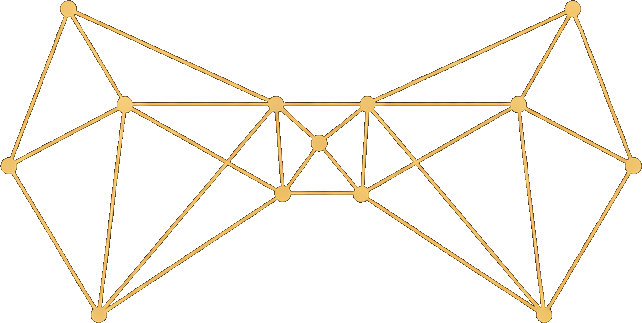
Part of Alfred’s six-layer architecture. The Semantic layer is where raw data becomes structured knowledge.
Your vault
The vault is where Alfred keeps everything it knows about your world. It’s a living map — an Obsidian-compatible collection of Markdown files with YAML frontmatter, all connected through wikilinks. Every person, project, task, decision, and insight lives here. Unlike a folder of notes, your vault is structured (every record has a type and metadata), connected (records link to each other), and growing (Alfred continuously adds and refines records as you share content).26 record types across five layers
Standing entities (8) — the stable elements of your world
Standing entities (8) — the stable elements of your world
Records for people, organizations, and resources that persist and accumulate connections over time.
| Type | What it represents |
|---|---|
person | People and contacts |
org | Organizations and companies |
project | Projects and initiatives |
location | Physical or virtual locations |
account | Accounts and subscriptions |
asset | Physical or digital resources |
process | Defined processes and workflows |
matter | An ongoing concern grouping related errands |
Activity records (9) — what happened
Activity records (9) — what happened
Events, work, interactions, and execution results — capturing what occurred and linking to the people and things involved.
| Type | What it represents |
|---|---|
conversation | Meetings, discussions, dialogue |
note | Observations and freeform content |
task | Execution primitives — errands carried out by Alfred or by you |
triage | Items Alfred couldn’t confidently classify — needs your review |
event | One-time occurrences |
session | Time-bounded work periods |
input | Incoming items being attended to |
run | Execution runs and batch operations |
ledger_entry | Completion records — what happened when an errand finished |
Execution types (1) — how work gets done
Execution types (1) — how work gets done
Methodologies that teach Alfred how to approach different kinds of work.
| Type | What it represents |
|---|---|
skill | A reasoning methodology — plain English instructions for a type of work |
Learning types (5) — what we know
Learning types (5) — what we know
Created by the Distiller from your records — the knowledge hiding between the lines.
| Type | What it represents |
|---|---|
assumption | Implicit assumptions found in your records |
decision | Choices made, with rationale |
constraint | Limitations and boundaries |
contradiction | Conflicts between different records |
synthesis | Insights connecting multiple records |
Intuition types (3) — how Alfred learns
Intuition types (3) — how Alfred learns
Created by Alfred’s intuition system as it learns your preferences over time.
| Type | What it represents |
|---|---|
observation | A routing decision Alfred observed and recorded |
instinct | A learned routing pattern, distilled from multiple observations |
reflection | A nightly report on what Alfred learned and refined |
How records connect
Every record can reference other records through wikilinks. When the Curator creates a person mentioned in a conversation, both records automatically link to each other. Over time, these connections build a rich, navigable map of your world. Example: You share notes from a planning meeting:- The Curator creates records: 3 people, 1 project, 2 tasks, 1 decision, and the conversation itself — all cross-linked
- The Janitor verifies all links are valid and metadata is consistent
- The Distiller later surfaces an assumption (“we’re assuming the API will be ready by March”) and a constraint (“budget is capped at $50k”)
- The Surveyor clusters these records with existing ones, revealing that this meeting’s topics overlap with three other recent discussions
Intuition — Alfred learns how you work
Over time, Alfred develops intuition — the accumulated understanding of your preferences. This isn’t a feature you configure. It emerges naturally from how you use Alfred. Observation — When you route an input, Alfred records the decision and the signals that characterized it. Reflection — Every night at 2am, Alfred reviews observations and distills them into instincts — learned patterns for how to handle recurring types of input. Judgment — When new inputs arrive, Alfred scores them against its instincts. Confident? It hands the input to the Curator with routing context (destination, assignee, process). Uncertain? It asks you. When Judgment routes an input, the Curator receives the raw content along with routing metadata — which project it belongs to, who it’s assigned to, and which process applies. The Curator then creates structured records, extracts entities, and interlinks everything with wikilinks. The resulting observation captures both the routing decision and the Curator’s output (entities found, links created), giving the learning loop richer signal for future instinct refinement. Alfred starts cautious, asking about everything. As evidence accumulates, it gradually handles more on its own — but always errs on the side of asking when uncertain. This is discretion — a good butler’s most important quality.Your Vault
How records, connections, and your world fit together
Record Types
Detailed reference for all 26 record types
Intuition
How Alfred learns your preferences